
42 million ETH and 7.16 million BTC sit behind exposed keys as the migration bill comes due
Recent studies reveal that 42 million ETH and 7.16 million BTC are vulnerable to potential quantum threats due to exposed public keys, highlighting the massive infrastructure upgrades required for the cryptocurrency sector.

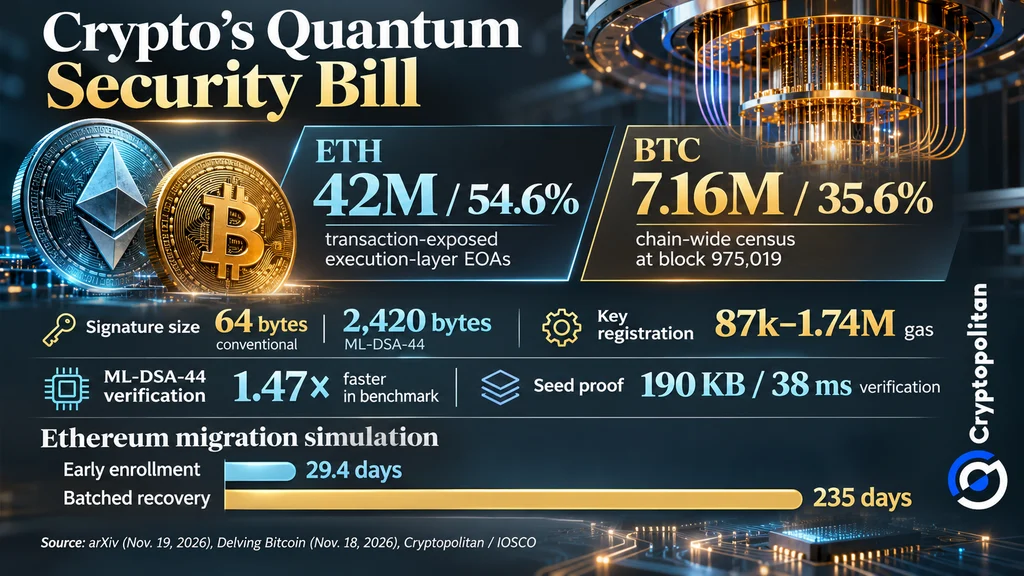
Two separate studies carried out in November have quantified the volume of cryptocurrencies vulnerable to a prospective quantum threat: roughly 42 million ETH and 7.16 million BTC. These numbers do not reflect ongoing thefts. Instead, they illustrate the scope of the infrastructure upgrades the entire sector must execute to guarantee future security.
For market participants such as custodians, exchanges, and investors, the central concern involves the financial burden of these upgrades, alongside their downstream effects on transaction fees, market liquidity, and investor confidence.
What an exposed public key actually means
When a user executes an initial Ethereum transaction, their digital signature supplies sufficient data for observers to extract their public key from the transaction record. This public key maintains a mathematical link to the private key needed to authorize subsequent user transactions. According to research from the University of Pittsburgh and Chicago-based security firm SeQure, this connection between public and private keys introduces a vulnerability. A sufficiently powerful quantum computer could leverage Shor’s algorithm to reverse-engineer the keys and drain funds from a user’s wallet.
Accounts that have never broadcast a transaction face lower risk. As Ethereum points out, the addresses for these accounts display only a hash of their public keys.
The danger of compromised private keys is already apparent even without quantum machines. An August 2026 USENIX study documented financial losses tied to compromised keys and alternative misuses of blockchain addresses.
Why the ETH and BTC estimates aren’t the same yardstick
The figures for Bitcoin and Ethereum cannot be directly compared because researchers employed differing methodologies to gauge exposure to potential quantum attacks.
The Ethereum investigation zeroed in on externally owned accounts (EOAs), which rely on private keys rather than smart contracts. Accounts that have exposed their public keys via transaction history hold approximately 42 million ETH, accounting for 54.6% of all ETH on the execution layer.
Regarding Bitcoin, a census released on November 18 analyzed the blockchain up to block 975,019. It revealed that roughly 7.16 million BTC reside in transactions featuring exposed public keys or spending scripts, representing 35.6% of all unspent Bitcoin.
Data from blockchain analytics provider Glassnode indicates that the volume of Bitcoin at risk from future quantum decryption climbed from 6.04 million BTC in May to 7.12 million BTC by November 10.
Ethereum’s two-speed migration, in days
Because millions of ETH sit in accounts with revealed public keys, Ethereum must devise methods to shift these assets into quantum-resistant storage rapidly. The speed of this migration may hinge on how promptly account holders take action.
The Pittsburgh-led analysis suggests permitting users to register quantum-resistant keys ahead of the retirement of Ethereum’s existing signature architecture. Individuals who miss this window could still recover their accounts by supplying cryptographic proof of ownership via their wallet recovery phrase.
The investigators modeled the migration of 4.45 million accounts holding a minimum of 0.1 ETH. Should every owner register ahead of time, the migration would wrap up in 29.4 days. If everyone relied on post-deadline recovery procedures, the timeline would stretch to 235 days.
The primary bottleneck is block space. Each recovery proof demands approximately 190 KB of data while requiring just 38 milliseconds to verify.
Ethereum’s developmental roadmap targets total quantum resistance by December 2029. To accelerate this objective, Ethereum developers discussed scaling back the Hegotá upgrade during a November 19 gathering.
Bitcoin’s draft fix is narrower by design
Bitcoin is weighing a more incremental strategy for quantum defense. The draft BIP-360 introduces Pay-to-Merkle-Root, a mechanism designed to secure bitcoin without exposing public keys upon receipt.
Even so, public keys could still be exposed when users spend their bitcoin. Shielding transactions from quantum threats during the confirmation period would necessitate further modifications to Bitcoin’s signature framework.
Coinbase, which reports holding about 12% of the overall Bitcoin supply, has proposed a phased transition permitting users to transact using either traditional or quantum-resistant signatures.
Where the cost actually shows up
A major hurdle in adopting quantum-resistant signatures lies in their physical size. A standard elliptic-curve signature takes up roughly 64 bytes, whereas ML-DSA-44, a standardized quantum-resistant alternative, requires 2,420 bytes.
Larger signatures do not inherently demand more time to verify. In one set of benchmarks, ML-DSA-44 verification ran 1.47 times faster than Ethereum’s traditional ECDSA signature verification.
Nonetheless, registering fresh keys can prove expensive. As Cryptopolitan noted, experimental tests on Ethereum documented registration expenses spanning from 87,000 to 1.74 million gas units.
On November 19, the International Organization of Securities Commissions cautioned that bloated signatures could dampen network throughput and push transaction fees upward. An experimental Solana testnet trial exhibited an approximate 90% drop in transaction handling capacity, though those findings do not necessarily mirror how Solana’s main network would behave.
Financial institutions also face substantial preparation hurdles. A risk assessment published by the European Banking Authority in November showed that a mere 8% of surveyed banks possess viable plans for transitioning to quantum-resistant cryptography.
For custodians and exchanges, the obstacles extend past upgrading core security infrastructure. Transferring massive quantities of cryptocurrency simultaneously could inflate settlement costs, while market liquidity could take a hit if large holdings are rendered temporarily inaccessible.
If you’re reading this, you’re already ahead. Stay there with our newsletter.


Comments 0 responses